 4b2c23703c
This implements the lq, stq, lqarx and stqcx. instructions.

These instructions all access two consecutive GPRs; for example the
"lq %r6,0(%r3)" instruction will load the doubleword at the address
in R3 into R7 and the doubleword at address R3 + 8 into R6.  To cope
with having two GPR sources or destinations, the instruction gets
repeated at the decode2 stage, that is, for each lq/stq/lqarx/stqcx.
coming in from decode1, two instructions get sent out to execute1.

For these instructions, the RS or RT register gets modified on one
of the iterations by setting the LSB of the register number.  In LE
mode, the first iteration uses RS|1 or RT|1 and the second iteration
uses RS or RT.  In BE mode, this is done the other way around.  In
order for decode2 to know what endianness is currently in use, we
pass the big_endian flag down from icache through decode1 to decode2.
This is always in sync with what execute1 is using because only rfid
or an interrupt can change MSR[LE], and those operations all cause
a flush and redirect.

There is now an extra column in the decode tables in decode1 to
indicate whether the instruction needs to be repeated.  Decode1 also
enforces the rule that lq with RT = RT and lqarx with RA = RT or
RB = RT are illegal.

Decode2 now passes a 'repeat' flag and a 'second' flag to execute1,
and execute1 passes them on to loadstore1.  The 'repeat' flag is set
for both iterations of a repeated instruction, and 'second' is set
on the second iteration.  Execute1 does not take asynchronous or
trace interrupts on the second iteration of a repeated instruction.

Loadstore1 uses 'next_addr' for the second iteration of a repeated
load/store so that we access the second doubleword of the memory
operand.  Thus loadstore1 accesses the doublewords in increasing
memory order.  For 16-byte loads this means that the first iteration
writes GPR RT|1.  It is possible that RA = RT|1 (this is a legal
but non-preferred form), meaning that if the memory operand was
misaligned, the first iteration would overwrite RA but then the
second iteration might take a page fault, leading to corrupted state.
To avoid that possibility, 16-byte loads in LE mode take an
alignment interrupt if the operand is not 16-byte aligned.  (This
is the case anyway for lqarx, and we enforce it for lq as well.)

Signed-off-by: Paul Mackerras <paulus@ozlabs.org>

Microwatt
A tiny Open POWER ISA softcore written in VHDL 2008. It aims to be simple and easy to understand.
Simulation using ghdl
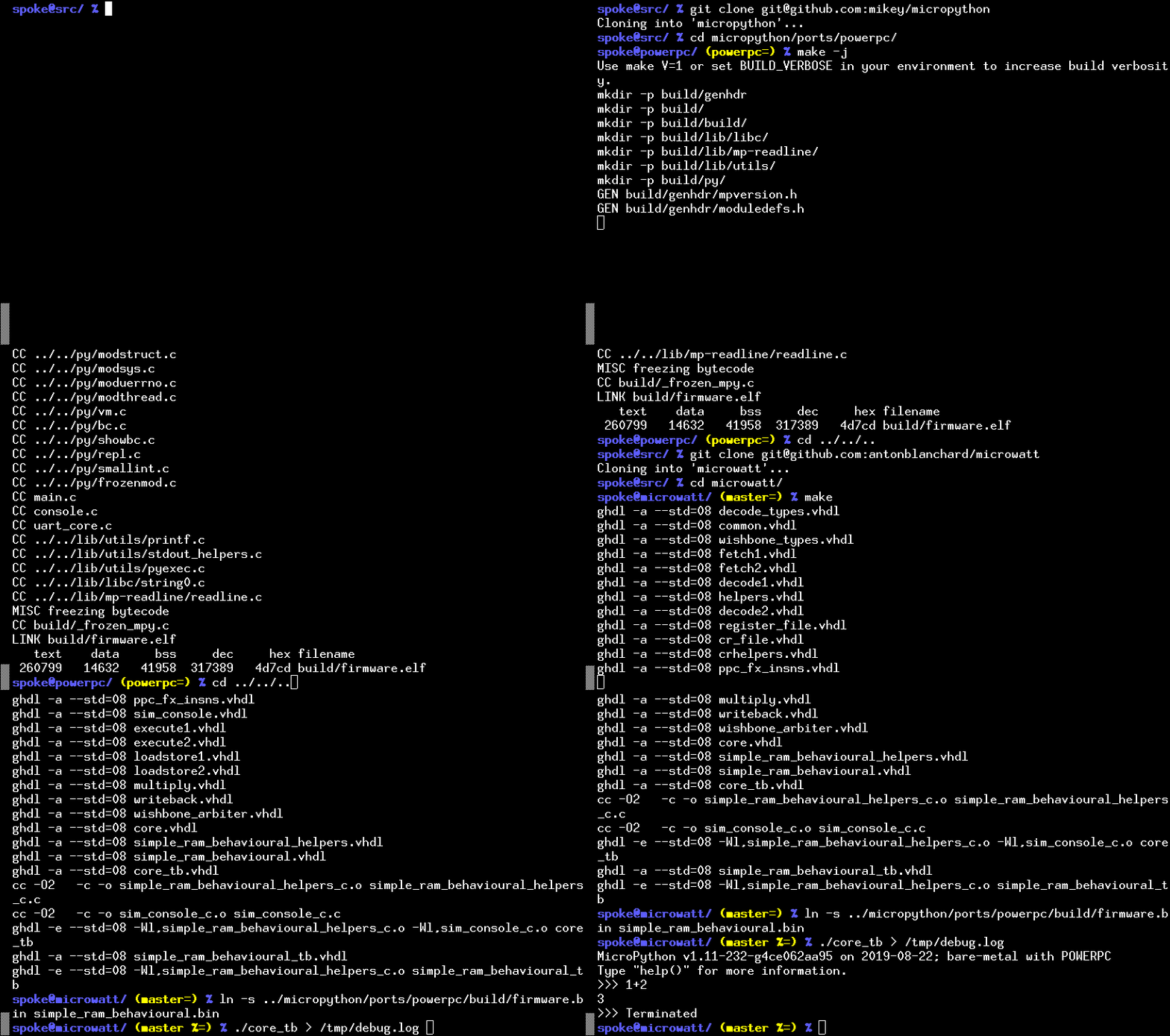
You can try out Microwatt/Micropython without hardware by using the ghdl simulator. If you want to build directly for a hardware target board, see below.
- Build micropython. If you aren't building on a ppc64le box you will need a cross compiler. If it isn't available on your distro grab the powerpc64le-power8 toolchain from https://toolchains.bootlin.com. You may need to set the CROSS_COMPILE environment variable to the prefix used for your cross compilers. The default is powerpc64le-linux-gnu-.
git clone https://github.com/micropython/micropython.git
cd micropython
cd ports/powerpc
make -j$(nproc)
cd ../../../
A prebuilt micropython image is also available in the micropython/ directory.
-
Microwatt uses ghdl for simulation. Either install this from your distro or build it. Microwatt requires ghdl to be built with the LLVM or gcc backend, which not all distros do (Fedora does, Debian/Ubuntu appears not to). ghdl with the LLVM backend is likely easier to build.
If building ghdl from scratch is too much for you, the microwatt Makefile supports using Docker or Podman.
-
Next build microwatt:
git clone https://github.com/antonblanchard/microwatt
cd microwatt
make
To build using Docker:
make DOCKER=1
and to build using Podman:
make PODMAN=1
- Link in the micropython image:
ln -s ../micropython/ports/powerpc/build/firmware.bin main_ram.bin
Or if you were using the pre-built image:
ln -s micropython/firmware.bin main_ram.bin
- Now run microwatt, sending debug output to /dev/null:
./core_tb > /dev/null
Synthesis on Xilinx FPGAs using Vivado
-
Install Vivado (I'm using the free 2019.1 webpack edition).
-
Setup Vivado paths:
source /opt/Xilinx/Vivado/2019.1/settings64.sh
- Install FuseSoC:
pip3 install --user -U fusesoc
Fedora users can get FuseSoC package via
sudo dnf copr enable sharkcz/danny
sudo dnf install fusesoc
- Create a working directory and point FuseSoC at microwatt:
mkdir microwatt-fusesoc
cd microwatt-fusesoc
fusesoc library add microwatt /path/to/microwatt/
- Build using FuseSoC. For hello world (Replace nexys_video with your FPGA board such as --target=arty_a7-100):
fusesoc run --target=nexys_video microwatt --memory_size=16384 --ram_init_file=/path/to/microwatt/fpga/hello_world.hex
You should then be able to see output via the serial port of the board (/dev/ttyUSB1, 115200 for example assuming standard clock speeds). There is a know bug where initial output may not be sent - try the reset (not programming button) on your board if you don't see anything.
- To build micropython (currently requires 1MB of BRAM eg an Artix-7 A200):
fusesoc run --target=nexys_video microwatt
Testing
- A simple test suite containing random execution test cases and a couple of micropython test cases can be run with:
make -j$(nproc) check
Issues
This is functional, but very simple. We still have quite a lot to do:
- There are a few instructions still to be implemented
- Need to add caches and bypassing (in progress)
- Need to add supervisor state (in progress)