 d458b5845c
At present, code (such as simple_random) which produces serial port
output during the first few milliseconds of operation produces garbled
output.  The reason is that the clock has not yet stabilized and is
running slow, resulting in the bit time of the serial characters being
too long.

The ECP5 data sheet says that the phase detector should be operated
between 10 and 400 MHz.  The current code operates it at 2MHz.
Consequently, the PLL lock indication doesn't work, i.e. it is always
zero.  The current code works around that by inverting it, i.e. taking
the "not locked" indication to mean "locked".

Instead, we now run it at 12MHz, chosen because the common external
clock inputs on ECP5 boards are 12MHz and 48MHz.  Normally this would
mean that the available system clock frequencies would be multiples of
12MHz, but this is a little inconvenient as we use 40MHz on the Orange
Crab v0.21 boards.  Instead, by using the secondary clock output for
feedback, we can have any divisor of the PLL frequency as the system
clock frequency.

The ECP5 data sheet says the PLL oscillator can run at 400 to 800
MHz.  Here we choose 480MHz since that allows us to generate 40MHz and
48MHz easily and is a multiple of 12MHz.

With this, the lock signal works correctly, and the inversion can be
removed.

Signed-off-by: Paul Mackerras <paulus@ozlabs.org>

Microwatt
A tiny Open POWER ISA softcore written in VHDL 2008. It aims to be simple and easy to understand.
Simulation using ghdl
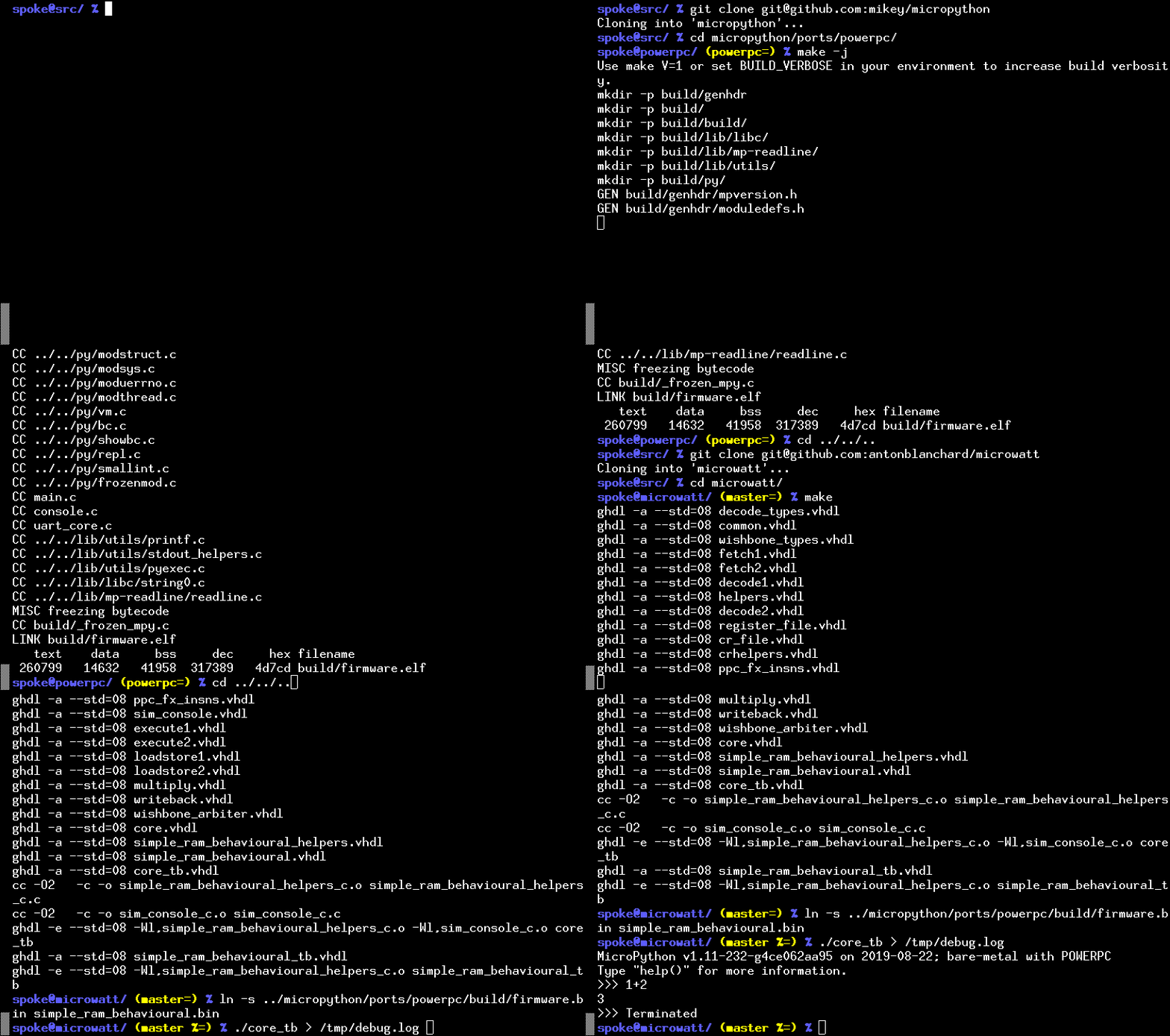
You can try out Microwatt/Micropython without hardware by using the ghdl simulator. If you want to build directly for a hardware target board, see below.
- Build micropython. If you aren't building on a ppc64le box you will need a cross compiler. If it isn't available on your distro grab the powerpc64le-power8 toolchain from https://toolchains.bootlin.com. You may need to set the CROSS_COMPILE environment variable to the prefix used for your cross compilers. The default is powerpc64le-linux-gnu-.
git clone https://github.com/micropython/micropython.git
cd micropython
cd ports/powerpc
make -j$(nproc)
cd ../../../
A prebuilt micropython image is also available in the micropython/ directory.
-
Microwatt uses ghdl for simulation. Either install this from your distro or build it. Microwatt requires ghdl to be built with the LLVM or gcc backend, which not all distros do (Fedora does, Debian/Ubuntu appears not to). ghdl with the LLVM backend is likely easier to build.
If building ghdl from scratch is too much for you, the microwatt Makefile supports using Docker or Podman.
-
Next build microwatt:
git clone https://github.com/antonblanchard/microwatt
cd microwatt
make
To build using Docker:
make DOCKER=1
and to build using Podman:
make PODMAN=1
- Link in the micropython image:
ln -s ../micropython/ports/powerpc/build/firmware.bin main_ram.bin
Or if you were using the pre-built image:
ln -s micropython/firmware.bin main_ram.bin
- Now run microwatt, sending debug output to /dev/null:
./core_tb > /dev/null
Synthesis on Xilinx FPGAs using Vivado
-
Install Vivado (I'm using the free 2019.1 webpack edition).
-
Setup Vivado paths:
source /opt/Xilinx/Vivado/2019.1/settings64.sh
- Install FuseSoC:
pip3 install --user -U fusesoc
Fedora users can get FuseSoC package via
sudo dnf copr enable sharkcz/danny
sudo dnf install fusesoc
- If this is your first time using fusesoc, initialize fusesoc. This is needed to be able to pull down fussoc library components referenced by microwatt. Run
fusesoc init
- Create a working directory and point FuseSoC at microwatt:
mkdir microwatt-fusesoc
cd microwatt-fusesoc
fusesoc library add microwatt /path/to/microwatt/
- Build using FuseSoC. For hello world (Replace nexys_video with your FPGA board such as --target=arty_a7-100): You may wish to ensure you have installed Digilent Board files or appropriate files for your board first.
fusesoc run --target=nexys_video microwatt --memory_size=16384 --ram_init_file=/path/to/microwatt/fpga/hello_world.hex
You should then be able to see output via the serial port of the board (/dev/ttyUSB1, 115200 for example assuming standard clock speeds). There is a know bug where initial output may not be sent - try the reset (not programming button) on your board if you don't see anything.
- To build micropython (currently requires 1MB of BRAM eg an Artix-7 A200):
fusesoc run --target=nexys_video microwatt
Testing
- A simple test suite containing random execution test cases and a couple of micropython test cases can be run with:
make -j$(nproc) check
Issues
This is functional, but very simple. We still have quite a lot to do:
- There are a few instructions still to be implemented
- Need to add caches and bypassing (in progress)
- Need to add supervisor state (in progress)