 1a7aebeef8
This adds a true random number generator for the Xilinx FPGAs which
uses a set of chaotic ring oscillators to generate random bits and
then passes them through a Linear Hybrid Cellular Automaton (LHCA) to
remove bias, as described in "High Speed True Random Number Generators
in Xilinx FPGAs" by Catalin Baetoniu of Xilinx Inc., in:

https://pdfs.semanticscholar.org/83ac/9e9c1bb3dad5180654984604c8d5d8137412.pdf

This requires adding a .xdc file to tell vivado that the combinatorial
loops that form the ring oscillators are intentional.  The same
code should work on other FPGAs as well if their tools can be told to
accept the combinatorial loops.

For simulation, the random.vhdl module gets compiled in, which uses
the pseudorand() function to generate random numbers.

Synthesis using yosys uses nonrandom.vhdl, which always signals an
error, causing darn to return 0xffff_ffff_ffff_ffff.

This adds an implementation of the darn instruction.  Darn can return
either raw or conditioned random numbers.  On Xilinx FPGAs, reading a
raw random number gives the output of the ring oscillators, and
reading a conditioned random number gives the output of the LHCA.

Signed-off-by: Paul Mackerras <paulus@ozlabs.org>

Microwatt
A tiny Open POWER ISA softcore written in VHDL 2008. It aims to be simple and easy to understand.
Simulation using ghdl
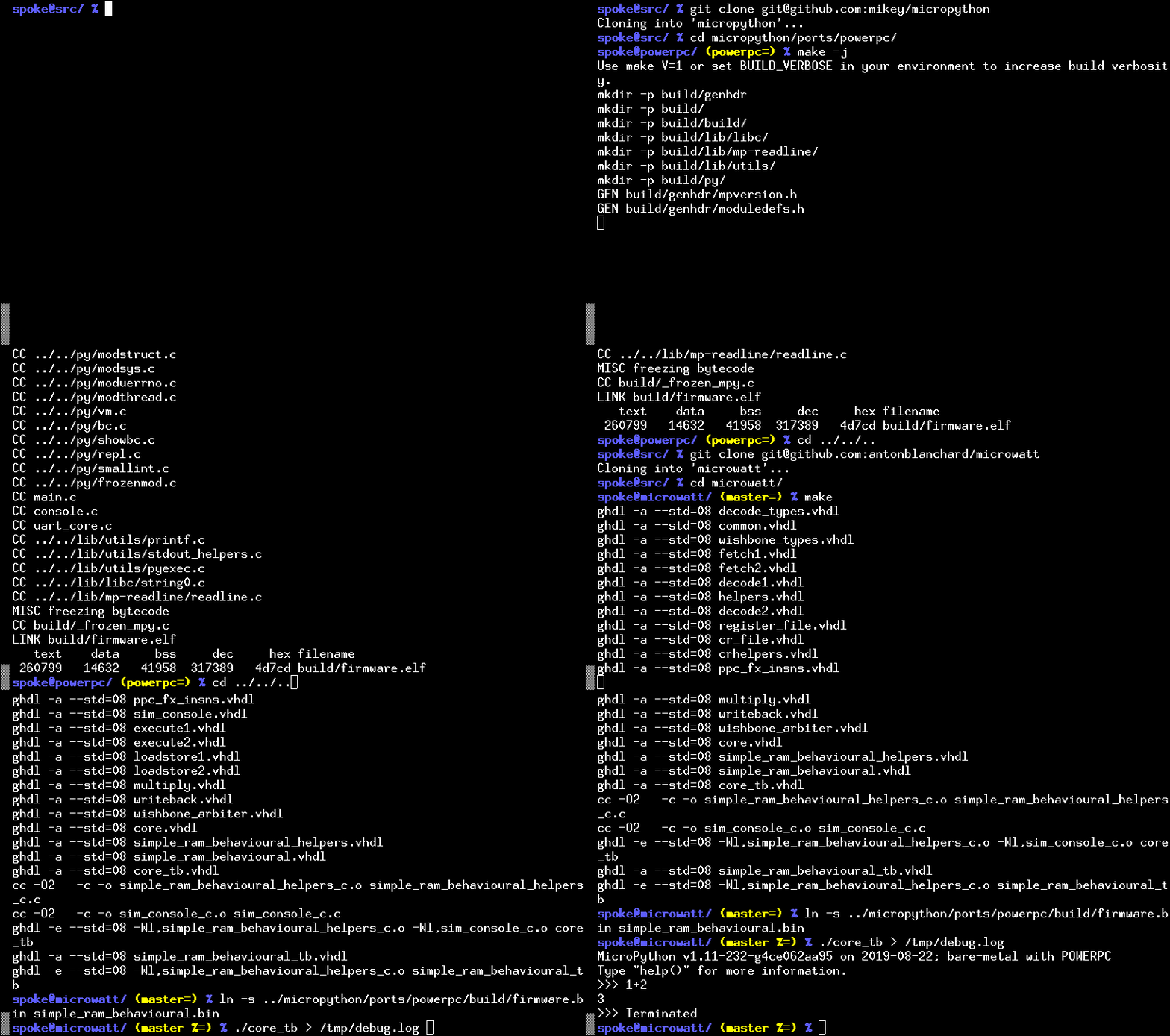
You can try out Microwatt/Micropython without hardware by using the ghdl simulator. If you want to build directly for a hardware target board, see below.
- Build micropython. If you aren't building on a ppc64le box you will need a cross compiler. If it isn't available on your distro grab the powerpc64le-power8 toolchain from https://toolchains.bootlin.com. You may need to set the CROSS_COMPILE environment variable to the prefix used for your cross compilers. The default is powerpc64le-linux-gnu-.
git clone https://github.com/micropython/micropython.git
cd micropython
cd ports/powerpc
make -j$(nproc)
cd ../../../
A prebuilt micropython image is also available in the micropython/ directory.
-
Microwatt uses ghdl for simulation. Either install this from your distro or build it. Microwatt requires ghdl to be built with the LLVM or gcc backend, which not all distros do (Fedora does, Debian/Ubuntu appears not to). ghdl with the LLVM backend is likely easier to build.
If building ghdl from scratch is too much for you, the microwatt Makefile supports using Docker or Podman.
-
Next build microwatt:
git clone https://github.com/antonblanchard/microwatt
cd microwatt
make
To build using Docker:
make DOCKER=1
and to build using Podman:
make PODMAN=1
- Link in the micropython image:
ln -s ../micropython/ports/powerpc/build/firmware.bin main_ram.bin
Or if you were using the pre-built image:
ln -s micropython/firmware.bin main_ram.bin
- Now run microwatt, sending debug output to /dev/null:
./core_tb > /dev/null
Synthesis on Xilinx FPGAs using Vivado
-
Install Vivado (I'm using the free 2019.1 webpack edition).
-
Setup Vivado paths:
source /opt/Xilinx/Vivado/2019.1/settings64.sh
- Install FuseSoC:
pip3 install --user -U fusesoc
Fedora users can get FuseSoC package via
sudo dnf copr enable sharkcz/danny
sudo dnf install fusesoc
- Create a working directory and point FuseSoC at microwatt:
mkdir microwatt-fusesoc
cd microwatt-fusesoc
fusesoc library add microwatt /path/to/microwatt/
- Build using FuseSoC. For hello world (Replace nexys_video with your FPGA board such as --target=arty_a7-100):
fusesoc run --target=nexys_video microwatt --memory_size=16384 --ram_init_file=/path/to/microwatt/fpga/hello_world.hex
You should then be able to see output via the serial port of the board (/dev/ttyUSB1, 115200 for example assuming standard clock speeds). There is a know bug where initial output may not be sent - try the reset (not programming button) on your board if you don't see anything.
- To build micropython (currently requires 1MB of BRAM eg an Artix-7 A200):
fusesoc run --target=nexys_video microwatt
Testing
- A simple test suite containing random execution test cases and a couple of micropython test cases can be run with:
make -j$(nproc) check
Issues
This is functional, but very simple. We still have quite a lot to do:
- There are a few instructions still to be implemented
- Need to add caches and bypassing (in progress)
- Need to add supervisor state (in progress)